

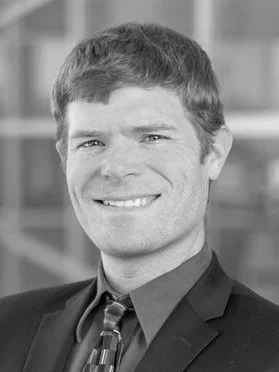
Matt Farmer
Assistant Professor, Utah Valley University
We became aware of Matt and his work through his co-authorship of "Marketing Ideas: How to Write Research Articles that Readers Understand and Cite". Matt completed his PhD at the University of Arizona in 2021, and teaches as an assistant professor at Utah Valley University. Matt provided valuable and encouraging perspectives on students’ ability to leave a mark with their final academic project – not by becoming widely known, but simply by helping the student reach a new insight into the investigated matter – and shared many actionable approaches to academic writing.
Matt's thoughts on the subject
A contextualizing theory chapter
“Finding papers can be daunting, especially if you’re in a very crowded discipline because basically, you’re trying to drink from a fire hose. And of course there are new papers being published every day. So, you’ve decades worth of papers to try to wrap your head around while also keeping up with current developments. It can be overwhelming. One useful tactic is to find others who have done an outstanding job of reading through that theory and attempt to use them as a starting-point. So instead of just diving into the deep end, you start with others who have plumbed those depths a lot, and use those as entry points. This way you can get your head around some of the initial ideas and topics. Textbook chapters are helpful for this kind of thing. And then you just go from there. And that way you’re starting off at the most important parts and then branching out into the rest of the material. Just like a tree: you start with the trunk, and then you branch out, instead of just trying to take it all in at once.” (Matt Farmer)
A progressive discussion
“The discussion is where you’re taking a further step back. And now you are looking at your results as a single piece of evidence in full detail. Now, taken together with the other findings, how does it fit into the larger group of studies or pieces of evidence of what you’re writing? You are ultimately writing for a critical audience that you are trying to convince. You are constantly moving up and down what we call the ladder of abstraction. Having those levels of abstraction along the way of explaining your ideas, it helps your audience. And it helps yourself to clarify your own thinking, too.” (Matt Farmer)
A resolving findings chapter
“Think of it as if it were a ladder where you are first describing the concrete, real world, what actually happened. What did these participants or subjects do when you did this manipulation? What was their response to it? These are your results. Then, you are taking a step back, to ask what these results mean on their own? You’re still just in the context. You’re standing there, the participants have just left the room, and you wonder what does that actually mean, what you just witnessed? What does this gathered insight, this data mean? How do I interpret that result? How do I translate that into the language that I’m using in the paper? Instead of recounting what happened, you use the more abstract terminology for it.” (Matt Farmer)
Castle under siege
“You should have an open mind and question the world around you and the surrounding decisions, but you should also sort of focus that inward as well. This means that our project, our work or thesis or our decisions can be improved. Our own project, work, thesis, and decisions should receive the scrutiny that help them grow and evolve, too. If we take that open curiosity mindset seriously, then we also need to recognize that other people who have that same mindset stay directed towards us. That is not a bad thing. It’s a good thing.” (Matt Farmer)
Fear of writing
“As far as approaching the paper more generally, I’ve benefited from not starting with the introduction, but rather starting with writing out whatever arguments you’re going to make—your storyline. For me, it has always been helpful to just start writing. Writing is so hard, you have all these ideas, especially if you have a decent idea of what you’re going to write. Are you reading a lot of literature instead of trying to create a perfect outline of everything you’re going to do? It can be helpful to just start writing about the topic, just getting your ideas on the page because often-times you don’t know what arguments are going to work.” (Matt Farmer)
Mitigating mental overload
“I really like the tactic of reverse-outlining: getting your ideas out first and then see which of these work, which don’t, and then make an outline from there. Once you’ve written out some core arguments or ideas that you want to make, not even in any order necessarily. I think this has just always been difficult for me. And I’ve noticed that other people can find it difficult to do an outline without having written anything. You just don’t necessarily know what a good logical order for the ideas would be. You don’t always know from the start which points you want to make. For example, when you’re writing a literature review, you don’t need to cite every single study or paper that’s ever been done on the topic. You just need to cite the ones that are most relevant to what you’re writing about. And that can be difficult to know until you’ve written some reviews out and see.” (Matt Farmer)
Revise frequently
“You don’t know what ideas will be the most effective to use until you start writing. And you may find after you’ve written a few pages: “this sort of line of logic that, I thought, was going to work is not right.” I hit a dead end—this doesn’t work. “I guess I wasn’t thinking it through all the way.” Our minds are very limited in what they envision in one go. Most people cannot envision a fully fleshed out argument. Just start to write it. It can break you free of that writing anxiety that I think we often get.” (Matt Farmer)
Take in your accomplishment
“Leaving a mark would require the student to rethink and draw new connections within a particular theory or phenomenon with their thesis. This would be how to get other researchers to read your thesis. It would make them rethink or re-examine something that they maybe thought they knew. That’s the direct way to make a mark, to change how practitioners or researchers think about a phenomenon and, indeed, part of the world. Indirectly, the thesis can also help the student themselves or their advisor. It can change how they think about or approach the problem. This can lead to other research projects or give them a unique perspective that they bring with them to a new workplace that can then shape their environments there. Both approaches are useful and effective in leaving a mark—be it directly or indirectly. It is unrealistic to expect that every thesis will receive great outside attention, but then, that’s not the only way of being successful. If you do something that truly shapes how you yourself and your supervisor look at the world, a mark has been left.” (Matt Farmer)
The purposeful scientific entrepreneur
“The strongest mindset that I try to maintain is curiosity about the world. To try and avoid taking too many things at face value. One of the things that companies benefit from is having a regular influx of new ideas and outside perspectives. If no one is asking questions, if no one is questioning the world around them, then we stagnate. We don’t grow. Growth and evolution happen through questioning, wondering. I’m trying to imagine, “What if we tried it this way?” ” (Mathew Farmer)
Write like a journey
“One of the best pieces of advice that I’ve ever got when it comes to writer’s block is to sit down with the sole intention to write a single paragraph. That is my current goal. If I sit down, and then I write the paragraph and I feel like writing more, that is bonus writing that you are getting. But if you sit down, and you write that paragraph, and you decide that you don’t want to, you can walk away. And nine times out of 10, when I sit down and write the first paragraph, I would rather not stop. It doesn’t even have to be the first paragraph.” (Matt Farmer)
Writing as modern architecture
“We write with the goal of showing things. We write with the goal of showing what we know about the literature, describing a process that hasn’t been described before, or just describing a theory as accurately or precisely as we can. However, those goals all differ from the goal of merely being understood. So being accurate or precise, for example, if that’s your overriding goal, then that is going to lead you to use a lot more jargon. Jargon feels like a very precise way to write about our research. Instead of saying “the process through which countries develop a market system”, you could just say “marketization”. Speaking of “marketization” is more precise . It’s denser and shorter, fitting, but it’s also less accessible. It can only be understood if someone happens to know what “marketization” means. By distancing language from the common day-to-day language that even academics use, you just make it a lot harder for people to understand what you’re saying. The best theory, the best thinking, the best contributions are not going to be seen or understood by most people unless you are writing about it in a clear way. I’m an advocate of that.” (Matt Farmer)