

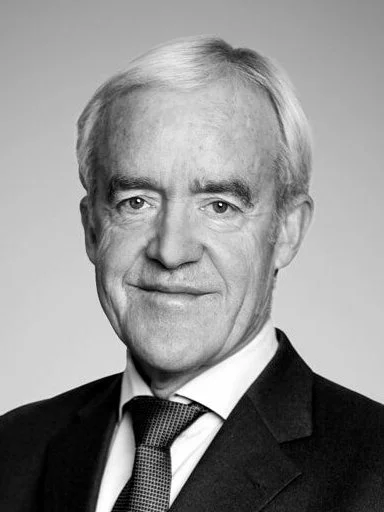
Günter Müller-Stewens
Professor Emeritus of Strategic Management, University of St. Gallen
Günter’s work as a scientific mentor is among the original inspirations for this book project. From 1991 until 2017 he was chair holder and professor of strategic management, and from 1997 until 2016 executive director of the Institute of Management & Strategy at the University of St. Gallen, where he also served as Dean of the School of Management. Günter shared a keen conviction about keeping research in the context of practical problems and their solutions, watching the modern academic publication system with doubt about how much it serves that goal – and encouraged identifying and following the inner spirit of a project and of oneself.
Günter's thoughts on the subject
A magnetic introduction
“First of all, the worst thing to do is to look for a research gap. That’s because maybe there are good reasons that there is a research gap: maybe there is simply no one interested in finding an answer to the so-called research gap. Often, people follow a research gap which is perhaps mentioned in the last paragraph of an article. That’s what I’d never recommend following.” (Günter Müller-Stewens)
Career serendipity
“You have to ask yourself for the path you would like to take. What kind of purpose do you see in your path? What is the achievement that you are trying to fulfil? Do you want to enter an academic career or not? As soon as you can answer that with a clear “Yes!”, then tactical elements enter your considerations. But that is usually not the case for Bachelor’s thesis; the question usually comes up when you are writing your doctoral dissertation. I would not recommend to any junior researcher to try to adopt the logic of academic journals. But of course, you have to take these considerations into account nowadays. This is the field of tension that you are subjected to if you aim for an academic career. There is also always an opportunity to find a third way—your own. This does not automatically mean that you turn an entirely blind eye to the tactical path.” (Günter Müller-Stewens)
Countless shades of supervision
“There are different types of supervisors. And not all types of supervisors are open to discuss possible research ideas with the students. So, there are supervisors who are treating their students as “slaves” to delegate some of the not-so-convenient research work they have to do. But that’s also, I think, the duty of the student to get information about the type of supervisor they are looking for.” (Günter Müller-Stewens)
Relevance follows audience
„My most important recommendation is to clearly understand and alignment with the problem you would like to help solve. To know precisely which practical problem you would like to tackle. This means not only to theoretically understand the problem, but to also, in the back of your mind, to develop an idea of how your research can help solve the problem.“ (Günter Müller-Stewens)
Renewable research energy
“You have to enter into discussion with yourself. What are your life plans? What is the design of your life? OK, maybe at the moment you don’t know exactly, and you can only do it like the start-up scene and go with prototyping and testing. Try if your heart beats in the direction of theoretical work, or are you more a type of consultant? You need a decision. Not from the beginning, but when you are saying to go to academia or at least you want to keep this path open to go to academia; later, in our times, you will have no choice but to learn the craft of publishing, of doing empirical research. There is no choice here. But even on this path, there is a choice of how you allocate your time.” (Günter Müller-Stewens)
Why even bother?
“I think there is such a thing as being “stuck in the middle” if you are trying to perfectly balance between academic and practitioner worlds. To my mind, any kind of work is also something spiritual. This does not have to be a religious term—“spiritual” means that there is a spirit and the spirit delivers you power for your work. You have to discover where the power for your work comes from.” (Günter Müller-Stewens)